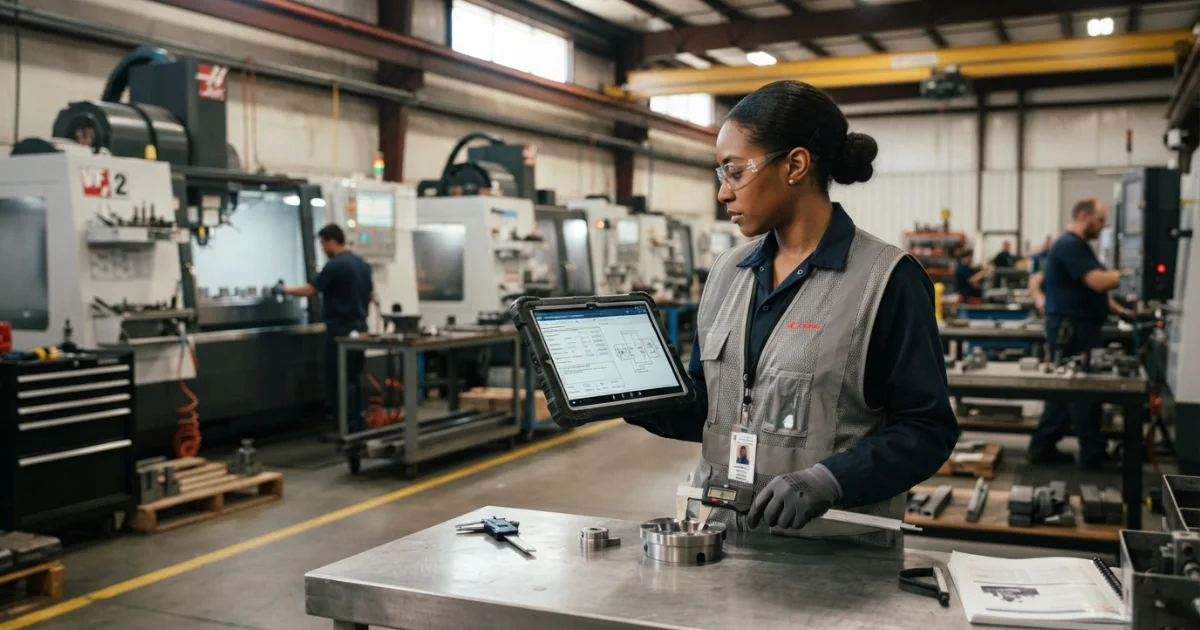
A precision metal fabricator with 220 employees ran quality inspections on paper. Inspectors measured parts, wrote results on sheets, and the sheets went into binders. Nobody could answer “which machine produces the most out-of-tolerance parts?” without a week of reading. Fourteen weeks later, inspectors use a quality inspection app on tablets that work without Wi-Fi, results sync to the ERP, and the first question the quality manager asked of the new data found a defect that had been costing the company scrap for years.
The situation
The fabricator ran Epicor for orders, inventory and routing, and the ERP had an inspection module nobody used because it needed a desktop terminal and a mouse. Inspectors worked at the machines, so they used clipboards. Results reached the ERP only as a pass or fail flag keyed in later. Measurements, photos of defects and operator notes never made it into any system.
In practice, that meant the paper held the useful information and the ERP held a summary. A sheet might record that a hole diameter came in 0.02 mm over on the fourth part of a run, with a note that the operator adjusted an offset. The ERP recorded “pass” for the lot. Key-in usually happened at the end of the shift, sometimes the next morning, and it was done by whoever had time.
When a customer raised a complaint, the quality team pulled binders by date range and read sheets until they found the lot. Scrap was visible only as a total in the ERP. The company knew how much it was losing each month. It could not say where, on which machine, or on which shift.
The goal and the constraint
The goal was inspection data captured at the machine, searchable the same day, and tied to the part, the machine, the operator and the shift in the ERP. The constraints: the shop floor had Wi-Fi in some bays and none in others, inspectors wore gloves and worked in oil and grit, and the ERP integration had to go through Epicor's REST API without customising the ERP itself.
Each constraint shaped a specific part of the design:
- Patchy Wi-Fi ruled out any app that needed a live connection to load a plan or save a result. Extending the network to every bay was quoted separately and would have taken longer than the software.
- Gloves, oil and grit ruled out consumer tablets, small buttons and anything that needed typing on a full keyboard. Inspectors would not take gloves off to tap a field, and they should not have to.
- No ERP customisation was the IT manager's condition. Custom tables and screens in an ERP tend to break or need retesting at every upgrade. A clean API integration keeps that cost with the integration layer, where it is easier to test.
What was built: an offline quality inspection app
- Tablet app: one Flutter app on rugged Android tablets. Inspection plans load per part from the ERP's routing; the inspector sees the characteristics to measure, enters readings with a large-touch keypad, photographs defects and adds notes by voice-to-text. Each reading turns green or red against the tolerance as it is entered, so an out-of-tolerance value is obvious before the inspector moves on.
- Offline-first: plans and results live in a local SQLite database. The app works for a whole shift without signal and syncs when the tablet is docked or passes a bay with Wi-Fi. Results are append-only on the tablet, so sync never has to merge two edits to the same record. A correction is a new entry that references the old one, which also keeps the audit trail intact.
- Integration: a .NET service between the app and Epicor. It reads routings and inspection plans, writes results into the ERP's inspection tables through the REST API, and keeps the photos and measurements in PostgreSQL where the ERP has no place for them. Writes to the ERP go through a queue with retries, so an ERP restart or maintenance window delays results rather than losing them.
- Quality dashboard: out-of-tolerance rates by part, machine, operator and shift, with the photos and notes one click away. Control-chart views for the characteristics the quality manager cares about.
- Team and timeline: three engineers and a designer, seven sprints, with two inspectors using the beta on one line from sprint three.
Putting the beta on the floor at sprint three was deliberate. The early screens were rough, but they showed where gloved fingers missed targets and which fields inspectors skipped. Those findings were cheap to fix in week six and would have been expensive in week fourteen.
The hard decision
Where the data should live. The ERP vendor's position was that everything belonged in Epicor. The ERP's inspection tables could hold pass, fail and one numeric value per characteristic; they could not hold photos, notes or the raw readings behind a control chart. We kept the ERP as the system of record for the result and built a parallel store for the evidence, linked by the ERP's own identifiers. The quality manager got the dashboard she wanted, the ERP got the flags it expected, and no one customised Epicor.
We looked at two other options. The first was extending Epicor with custom fields and attachments to hold everything. That would have kept a single database, but it broke the no-customisation constraint and would have added retesting to every future upgrade. The second was a standalone inspection system that ignored the ERP. That would have been faster to build, but shipping and purchasing already relied on the ERP's pass and fail flags to release lots. Taking those flags away would have moved the paperwork problem from quality to shipping.
The split has a cost. Two stores means the link between them has to be right. The integration service rejects any result that does not match a valid ERP job and operation, so the evidence store cannot hold records the ERP does not know about.
Results
Within a month of rollout the quality manager used the new dashboard to ask which machine produced the most out-of-tolerance parts on a particular bracket. One machine on the second shift stood out. A worn fixture was found and replaced. Scrap on that line fell by about 60 percent over the following quarter, measured from the ERP's own scrap records. Inspections take roughly the same time as on paper, which was the condition for inspectors to accept the tablets. The binders are gone.
That scrap figure applies to one line and one root cause. We do not claim the app reduced scrap across the plant by that amount. What the app changed is how fast a pattern like that can be found. The fixture had likely been wearing for a long time. On paper, the pattern was spread across hundreds of sheets in several binders. On the dashboard, it took a few filters.
Inspection-time parity was checked by timing inspectors on the beta line against their paper routine. Faster was not the target. Not slower was. If the tablet had added minutes per inspection, inspectors would have gone back to clipboards and keyed results in later, and the project would have recreated the old problem.
What we would do differently
Buy the tablet cases before choosing the tablets. The first batch of rugged tablets were fine, but the only cases available for them blocked the camera at the angle inspectors naturally held the device. Two weeks of photo complaints later, the company swapped to a different model.
The broader lesson is to test the full hardware setup on the floor before buying in volume: tablet, case, mount, dock and charger together. A single kit, used by one inspector for a few shifts, would have caught the camera problem before the order went in.
How a project like this starts
With a shift on the floor. We watched inspections on three lines before we drew a screen, and the glove-and-grit reality shaped the whole interface. Discovery then names the ERP integration path, the offline rules and the devices, and ends in a scope with a fixed price. If your inspections are on clipboards, tell us about it.
For a plant this size, discovery typically takes two to three weeks. It produces a short list of what we need from you: read access to the ERP's API in a test environment, a few completed inspection sheets for your highest-volume parts, and a quality lead who can answer questions within a day. It also produces a list of what can wait for a second phase, so the first release stays small enough to ship on time.
Frequently asked questions
Did the fabricator customise its ERP?
No. Everything went through Epicor's REST API, so ERP upgrades are unaffected. The integration service is the only component that needs retesting when the ERP changes. That testing is limited to the handful of calls it makes.
How do inspectors handle the tablets with gloves?
Large touch targets, a numeric keypad designed for gloved fingers, and voice-to-text for notes. Inspectors tested every screen before it shipped. Free-text typing was kept to a minimum, because it is where gloved input fails most often.
What about compliance documentation?
Every inspection result is timestamped, attributed to the inspector and the tablet, and exportable with its photos for customer audits. The company's ISO auditor reviewed the system at the next surveillance audit without findings. Because corrections are stored as new entries rather than overwrites, the original reading is always available alongside the change.