A commercial HVAC contractor with 60 technicians scheduled the day on a whiteboard, tracked it in a spreadsheet, and coordinated changes in three group chats. Double-bookings happened weekly, site history lived in technicians' heads, and invoices went out days after the work from paper tickets. Eighteen weeks later, dispatch runs from one board, technicians carry the job and the site's history on their phones in a field service management app, and completed work becomes an invoice the same day.
This is how that field service management app was scoped and built, the decision we argued about most, and what we would change if we started again.
The situation
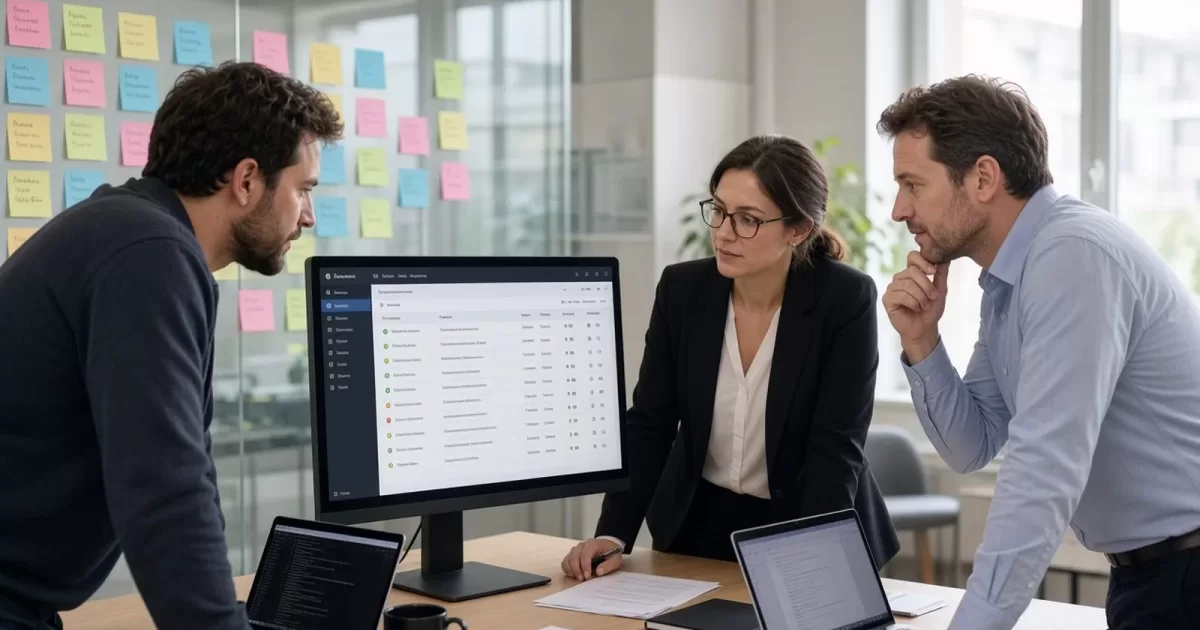
The contractor had outgrown its tools without noticing. Two dispatchers managed the whiteboard and the spreadsheet; when a job overran, the change went out by group chat and sometimes two technicians arrived at the same site. Maintenance contracts specified quarterly visits that were tracked on a calendar nobody trusted. The office keyed paper job tickets into QuickBooks at the end of each week.
Each of those gaps had a cost the company could feel. A double-booking is a wasted truck roll. Once you count travel, that is typically a few hours of a technician's paid time with nothing billable at the end of it. A missed quarterly visit is a contract the customer starts to question at renewal. A week-old paper ticket is an invoice that goes out late and gets disputed more often, because nobody remembers the job clearly.
Site history was the quieter problem. A senior technician knew which rooftop unit had a seized damper and where the key to the plant room was kept. When he was on leave, the next technician started from nothing. That knowledge was the company's, but it was stored in one person's memory.
The goal and the constraint
The goal was one source of truth for the day, visible to dispatch and technicians, and invoices out the same day. The constraints: the technicians' phones had no signal in plant rooms and basements for much of the working day; QuickBooks had to remain the accounting system; and the owner wanted no change to how customers were billed, only to how fast.
Each constraint shaped the design. No signal meant offline could not be a later feature. An app that needs a connection to open a job fails in the exact place the job happens. Keeping QuickBooks meant the office staff and the outside accountant kept the tool they knew, and it kept a ledger migration out of scope. Keeping billing unchanged meant the same rates, the same contract terms and the same invoice layout. Customers would notice only that invoices arrived sooner.
What was built: a field service management app and dispatch board
- Dispatch board: a React web application with a day and week view by technician, drag-to-assign, travel-time estimates between jobs, and contract visits generated automatically from each maintenance agreement.
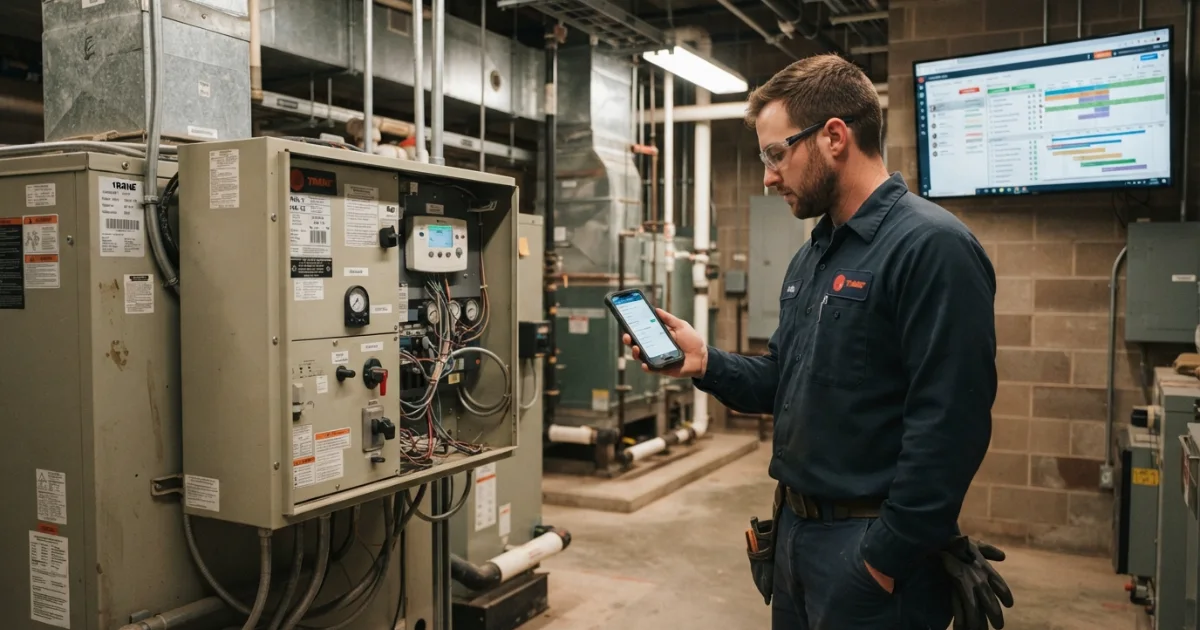
- Technician app: React Native for iOS and Android. The day's jobs, site access notes, equipment history and previous visit notes, a parts list with the truck's stock, photo capture, customer sign-off and a time log.
- Offline-first: jobs and history cached locally each morning; every action queued and synced when the technician has signal again. Dispatch sees a “last seen” time rather than stale data presented as live.
- Accounting integration: a completed, signed job becomes a draft invoice in QuickBooks through its API with labour, parts and photos attached, for the office to approve and send.
- Team and timeline: four engineers and a designer across nine sprints, with four technicians and one dispatcher on the beta from sprint four.
Nine sprints in eighteen weeks means two-week sprints. The first three built the data model, the board and a bare technician app. The beta group joined at sprint four so that real jobs, not test data, drove the remaining five.
Contract visits worked like this. Each maintenance agreement stores its frequency, its sites and the equipment covered. The board creates the visits for the coming period as unassigned jobs. A dispatcher places them around reactive work. A visit cannot quietly vanish, because an unassigned contract visit stays on the board until someone schedules it or records why it moved.
Offline sync needs rules for conflicts, and we wrote them down before writing code. The core rule: what happened on site wins. If a technician starts a job while offline and dispatch reassigns it in the meantime, the technician's record stands when the phone syncs. Dispatch gets an alert to sort out the clash. The alternative, silently overwriting work a technician has already logged, is how field teams learn to distrust an app.
Good offline behavior looks boring. The technician never sees a spinner in a basement. Bad offline behavior shows up as photos lost on sync, duplicate time entries, or a board that shows a technician as idle because his phone has been underground for two hours. The “last seen” time exists to prevent that last one.
The hard decision
Whether to build a customer portal in version one. Customers asked for visit confirmations and reports, and the owner wanted to offer them. We held it to version two. Version one had to win the technicians, and every week spent on a customer portal was a week not spent on the app they would use eight hours a day. The portal shipped four months after launch, built on the data the app had been collecting all along, and took five weeks.
The reasoning was about dependency. A portal shows visit reports, photos and sign-offs. All of that comes from the technician app. If technicians had not adopted the app, the portal would have had nothing reliable to show, and customers would have seen gaps. Building the source first meant the portal launched with months of real history behind it.
The owner's concern was fair: some customers had asked directly. The compromise for those four months was simple. The signed job record and photos were already attached to each QuickBooks invoice, so customers received proof of the visit with the bill.
Results
Double-bookings stopped in the first month; the board does not allow two technicians on one job without a dispatcher choosing it. Completed jobs per technician per day rose about 15 percent over the first quarter, measured from the app's own records against the previous spreadsheet. Invoices went out a median of one day after the work instead of five, measured in QuickBooks. First-time fix rate improved, which the service manager attributed to technicians arriving with the site history and the right parts.
We read these numbers with care. The 15 percent compares two different ways of recording work, so we treat it as a strong direction rather than an exact figure. The invoice timing is the cleanest measure, because QuickBooks timestamps both the job and the invoice. First-time fix rate was not tracked before the app, so we report that one as the service manager's judgment, not a percentage.
What we would do differently
Handle the truck stock earlier. The parts list was built against a clean inventory that did not match what was actually on the trucks, and the first two weeks produced a lot of “part not found” notes. A physical count of ten trucks in discovery would have shown the gap.
A count like that typically takes an hour or two per truck, with a technician and someone from the office. It would have shown which parts were stocked under a different name, which were carried informally, and how far the records had drifted. We would then have loaded each truck's real stock before the beta, not fixed it from technicians' notes afterward. The lesson carries beyond HVAC: before building against a data set, check it against the physical world it claims to describe.
How a project like this starts
With a day at the dispatch desk and a day in a truck. Both showed us the double-booking problem and the signal problem before anyone described them. Discovery then fixes the offline rules, the accounting integration and the devices, and ends in a scope with a fixed price. If your dispatch runs on a whiteboard, tell us about it.
Discovery for a project of this size typically runs two to four weeks. You get a written scope, the conflict rules for offline sync, a list of the integrations and what each one does, and a price. If the scope does not hold up, you have spent weeks, not the budget for a full build.
Frequently asked questions
Why not buy an off-the-shelf field service product?
The contractor evaluated three. Each would have changed how it quoted, billed and ran maintenance contracts to fit the product. Building let the company keep its processes and own the result.
Off-the-shelf can be the right call. If a product fits your contracts and billing with little change, buying it is usually faster and cheaper. Custom pays off when the product would force you to change how you sell and bill.
How do technicians handle the app with no signal?
Everything they need for the day is on the phone by 7 a.m. They work normally and the app syncs when it can. Dispatch sees when each technician last synced.
Does the office still touch QuickBooks?
Yes, to approve and send invoices. The data entry is gone.
Each invoice arrives as a draft with labour, parts and photos attached. The office checks it and sends it. Nobody keys in a paper ticket.